

«I’m back from my summer holidays, but I still don't feel properly rested.» I've heard this sentence a lot over the past few days.

Not just from people who are already exhausted, but also from executives, entrepreneurs and ambitious individuals who want to protect their energy before it runs out. Many of them get enough sleep, exercise regularly and make time for breaks. And yet, they still feel as though their batteries never quite reach full charge.
In situations like these, we often draw on a framework developed by American physician Dr Saundra Dalton-Smith. Although research doesn't classify exhaustion into these exact seven categories, we find the model useful in coaching. It helps people look at their personal energy reserves from a more differentiated perspective and ask themselves: What kind of rest do I actually need?
Because perhaps you don't need more sleep. Perhaps what you're missing is something entirely different.
Rest is about more than sleep
When we think about recovery, most of us think of sleep first. That's hardly surprising. Physical recovery is essential, and research clearly shows how strongly sleep affects our health, concentration and emotions.
Yet most of us know what it's like to wake up feeling tired despite having had eight hours of sleep. Or to reach the end of a long weekend and realise that we still don't feel properly recharged.
Recovery is more complex than that. Different areas of our lives can either give us energy or drain it. If one of these areas remains depleted over time, simply catching up on sleep often isn't enough to make up for the deficit.
It's already a great starting point to ask yourself how much energy you currently have in your personal battery:
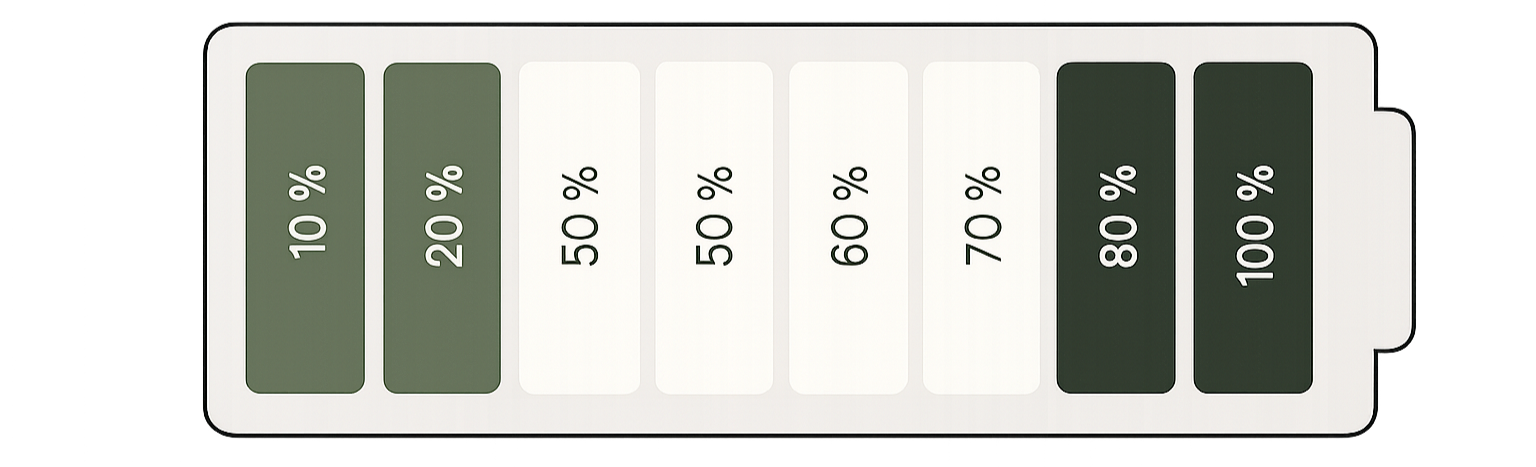
But it's worth taking a closer look: why is your energy low, moderate or high? To explore this, we use Dalton Smith's seven types of energy or rest, with a few minor adaptations, and ask our clients to position a slider according to how energised they currently feel in each area.
This opens up more nuanced conversations. Most importantly, it helps identify clear ways to restore energy, and where to start.
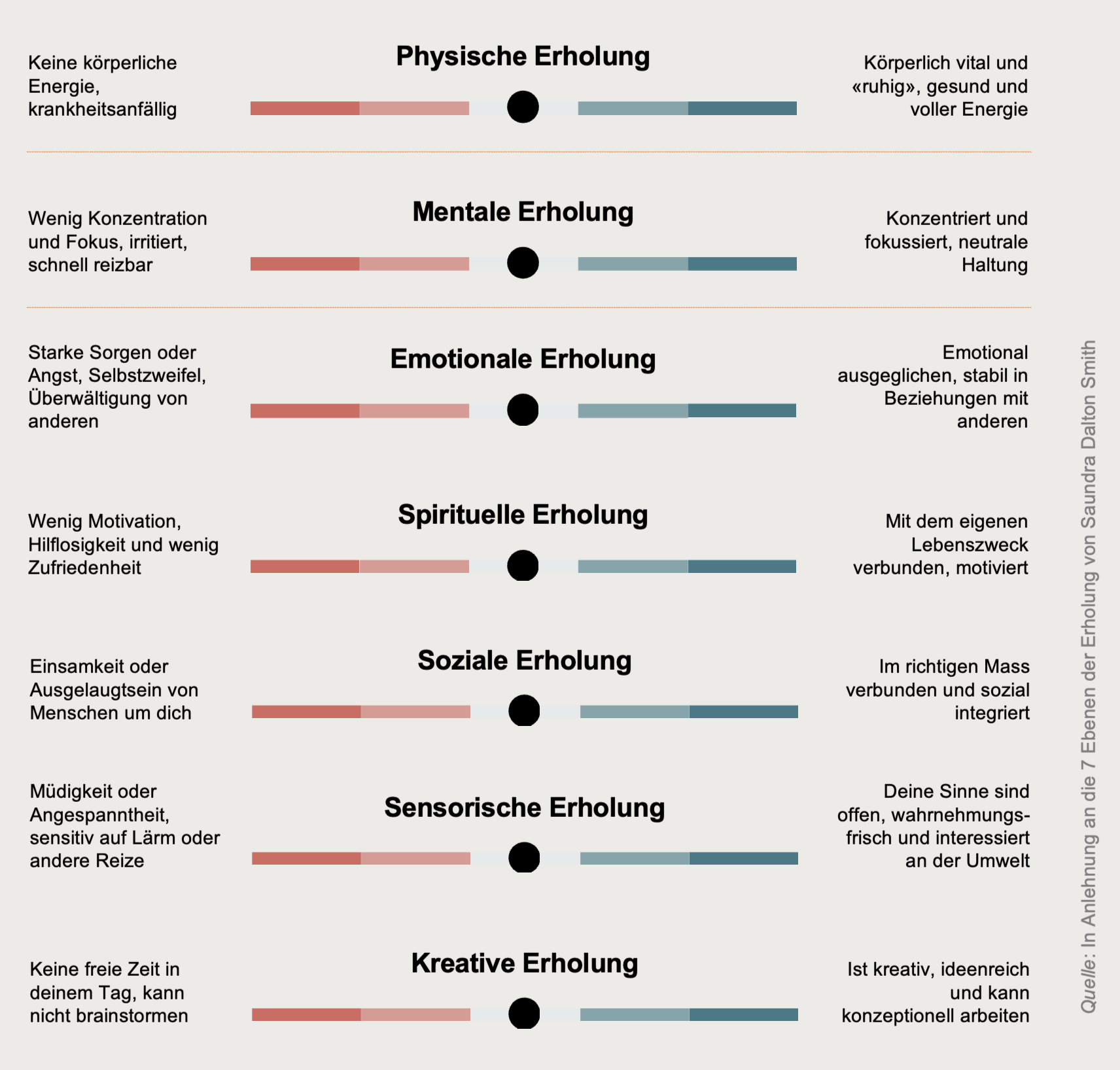
Based on Saundra Dalton-Smith's seven types of rest (excerpt from our «Mental Strength» workbook, German only)
1. Physical rest: physical energy
Physical exhaustion is the most obvious form of depletion. Poor sleep, intense workouts, long working days or too little movement all take their toll. Your body lets you know through heavy legs, muscle tension or the feeling that you're never truly rested.
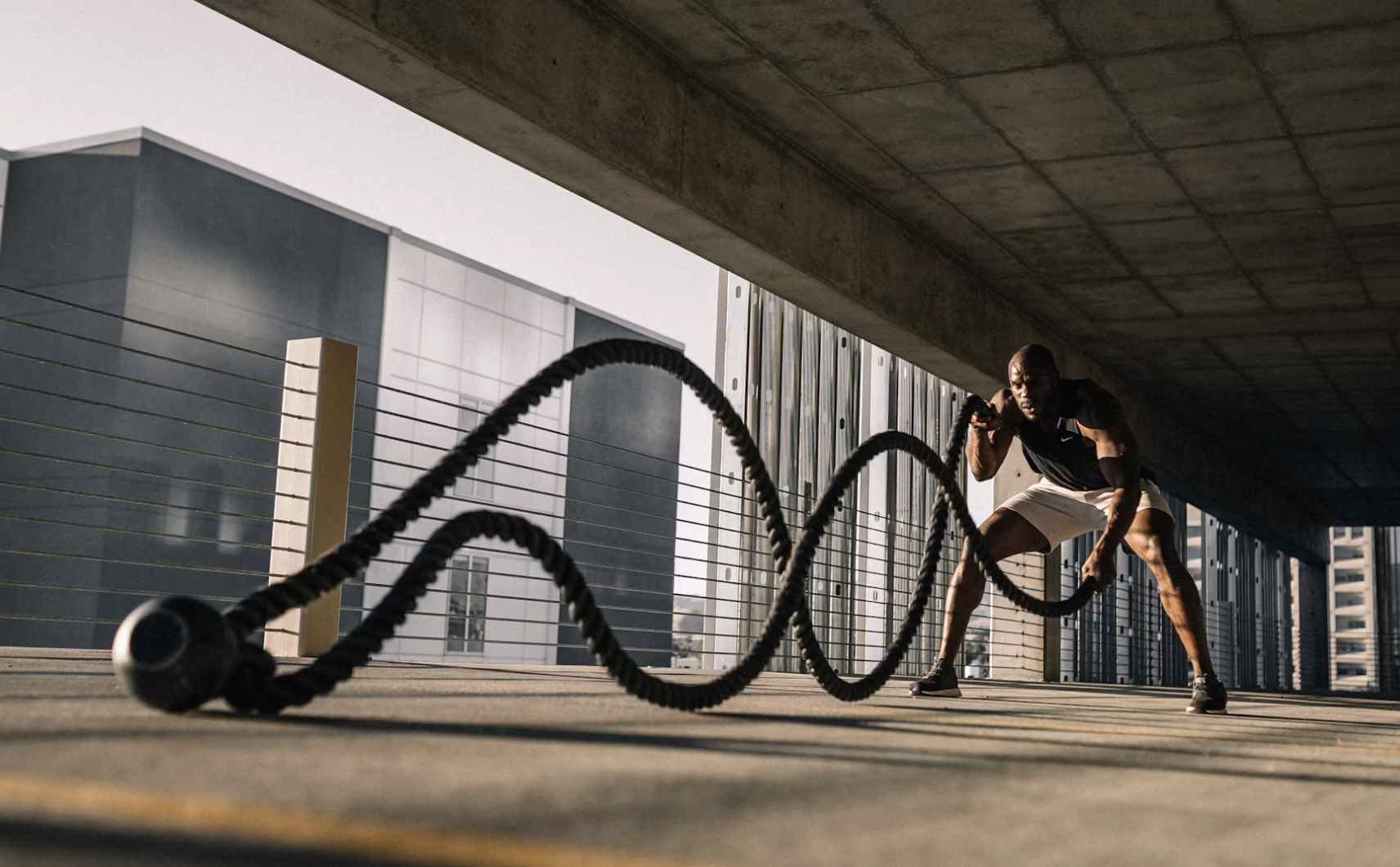
People who are driven to perform often respond by becoming even more disciplined. They keep training, keep working and hope that the next free weekend will somehow put everything right.
Sometimes, however, the opposite is exactly what you need: a walk instead of an intense workout, a short break in the middle of the afternoon or a night when sleep takes priority over productivity.
2. Mental rest: mental energy
Perhaps you know the feeling: you're sitting on the sofa, but your mind is still attending three meetings, planning the weekly shop, mentally replying to emails and already thinking about tomorrow.
Mental exhaustion isn't necessarily caused by having too many tasks. Often, it's because our brains never get the chance to switch off properly. Our attention jumps constantly from one topic to another.
What helps is surprisingly simple, yet not always easy: getting your thoughts out of your head and onto paper, consciously focusing on one thing at a time or regularly giving your brain moments when it doesn't have to solve anything. It's no coincidence that studies show how even short periods without constant stimulation can improve our attention and concentration.
3. Emotional rest: emotional energy
There are days when we're not physically tired, yet still come home feeling exhausted. Often, emotional labour is behind it.

VPerhaps you've tried to remain professional even though something hurt you. Perhaps you've avoided conflict, put other people's needs first or given the impression that everything was fine.
Emotional energy is often drained when we spend too much time playing a role instead of being free to be ourselves. That's why recovery in this area has less to do with free time and more to do with honesty. An open conversation, a clearly communicated boundary or simply giving yourself permission to ask: How am I really feeling right now?
4. Spiritual rest: energy through purpose
The term may sound unfamiliar at first. But it doesn't necessarily refer to religion. It's about feeling connected to something greater than the demands of everyday life.
When this sense of «why» is missing, even small tasks can feel overwhelming. In coaching, we often meet people who aren't struggling because of their workload, but because they've lost touch with what truly matters to them.
Sometimes, simply asking yourself this question can help: Does the way I spend my time serve the things that genuinely matter to me? For one person, that might be nature. For someone else, meditation, music, faith, time with family or a personal vision for life.
In a world full of appointments and to-do lists, it's easy to lose touch with precisely these moments. Yet they're often what remind us why we want to spend our energy in the first place.
5. Social rest: energy from relationships
Not every person drains your energy. And not every person replenishes it.
Perhaps you know both experiences: encounters that leave you feeling light, connected and inspired, and others after which all you want to do is go home.
Empathetic people in particular often underestimate how differently relationships can affect their energy levels. It's worth paying attention to which connections nourish you and which primarily drain you. Sometimes, self-care isn't about spending more time with people, but about being more intentional about whom you spend it with.
In September 2026, we'll be exploring exactly this topic in our community. We'll take a closer look at our «social environment», using tools and models to help you reflect honestly on your relationships of all kinds. Join us today!
6. Sensory rest: energy from reducing stimulation
We live in a world full of stimuli. Screens, notifications, conversations, noise and constant multitasking often place more demands on our nervous systems than we realise. Open-plan offices, crowded trains, large groups of people. Particularly for highly sensitive people or those with demanding work routines, this can lead to a form of exhaustion that feels more like sensory overload than tiredness.

Sensory rest means regularly giving your brain moments with fewer stimuli. Going for a walk without headphones, spending a few minutes in silence between appointments, consciously putting your phone aside or spending time in nature can all help your nervous system settle.
7. Creative energy: energy through immersion
Creativity has little to do with artistic talent. Rather, it describes our ability to generate new ideas, recognise connections and remain curious.
This kind of energy is particularly depleted when every day looks the same and our minds are simply going through the motions. That's why many people have their best ideas while hiking, travelling or even in the shower. Not because they're trying harder, but because their brains finally have room to think freely.
Nature, music, books, immersive activities such as deep work, or simply doing nothing for a while can all replenish this source of energy.
Why it pays to take a closer look at your energy levels
When working with clients, we rarely start by asking: «How much do you sleep?» Instead, we tend to ask: «Where is your system losing energy right now?»
Physical tiredness requires something different from emotional exhaustion. Mental overload calls for a different kind of recovery than a loss of purpose.
Perhaps this is the most important insight the model offers: recovery isn't something we take care of once in a while, somewhere between two holidays. It begins when we understand which source of energy needs our attention right now.
I used to come home after a demanding day facilitating a full-day workshop and put on a challenging podcast about neurobiology in the evening. Today, I choose to slow down and consciously step away from stimulation.
What kind of energy do you need right now?
Take a moment to assess your seven energy levels intuitively. Which one feels most replenished right now? And which one has perhaps been quietly calling for your attention for some time?
Because sustainable recovery rarely comes from simply doing more. It comes from nourishing what you actually need.