

How much self-optimisation is too much? How much enjoyment do we need? Should you drink that awful green juice or enjoy a chai latte instead? Watch a little more Netflix or go to bed earlier? Track your fitness data or listen to how you feel? Many of these questions ultimately lead to one bigger question: Is my life worth living? Here's myanswer. And a checklist to help you assess how well-trained your mind is when it comes to living a good life for as long as possible.
#Longevity #MentalStrength #DisciplineOrEnjoyment
Self-optimisation or enjoyment? Or: longevity, Bryan Johnson and «Don't Die»
The inspiration for this blog post came from the Netflix documentary Don't Die: The Man Who Wants to Live Forever, about Bryan Johnson. Johnson is an American technology entrepreneur and biohacker who has become known for his efforts to slow down the ageing process and extend human longevity. His project, «Blueprint», aims to reverse his biological ageing process.
To give you an idea of what this involves, Johnson's daily routine includes a strict plant-based diet, intensive training programmes and a wide range of supplements. He regularly undergoes medical tests to monitor the effects of his interventions. His efforts have reportedly reduced his biological age by more than five years.

The splits and food
Aside from the fact that I do quite a few of the things he does (though I don't do the splits while eating), one of his statements really got me thinking: «Remove your mind». He takes a data-driven approach to health optimisation, continuously measuring various biomarkers to make precise decisions about his diet and lifestyle. This objective approach is designed to minimise subjective choices, relying instead on scientific data and AI to manage his health.
The documentary reflects many of the conversations I have with other people. They keep coming back to the same questions: What makes life worth living? How much enjoyment does life need to be worth living? And why has enjoyment become the overriding principle in our society?
Where does the idea come from that everything we eat has to taste good?
I find myself having this conversation time and again when people ask me how much I sleep, why I drink blended green vegetables, how much money I spend on micronutrients or why I willingly have blood tests every six months. I've realised that some people immediately assume I'm sacrificing everything to discipline, and that my life must therefore be monotonous, exhausting or devoid of enjoyment. After all, green juice doesn't exactly taste great.

My green juice is made with spinach, leafy greens, barley grass powder, other supergreens and a little banana.
That's true. But it's not that bad either. Drinking it takes about 30 seconds. The positive effects last much longer. When I drink green juice regularly, my wounds heal faster, my skin looks more even and I feel better physically. Beyond these subjective benefits, regular green juice consumption is also reflected in better heart health markers, in other words, measurable data. In conversations like this, people may come to understand why I drink green juice, but they still don't want to try it themselves. And that's absolutely fine, as long as they leave me in peace when I drink mine.
Many people are convinced that food should always taste good. I enjoy good food, too. But what I enjoy most is food that both nourishes me and tastes good. We live in a society that consumes too much yet is undernourished, a society that has lost touch with what health really means. Being overweight has become so normalised and accepted that people who eat vegan, follow other dietary principles or live like Bryan Johnson are in the minority, and even face criticism for it.
I find myself wondering: when did caring about health become so frowned upon? And why do people who choose to live differently or try something new attract criticism? After all, our pursuit of pleasure hasn't exactly got us very far. The expectation that everything should always taste good and be readily available has coincided with an alarming global rise in health problems such as excess weight, obesity and chronic disease, despite significant advances in medicine and unprecedented material prosperity.
According to the World Health Organization (WHO), 1.9 billion people worldwide were overweight in 2016, including 650 million people living with obesity.
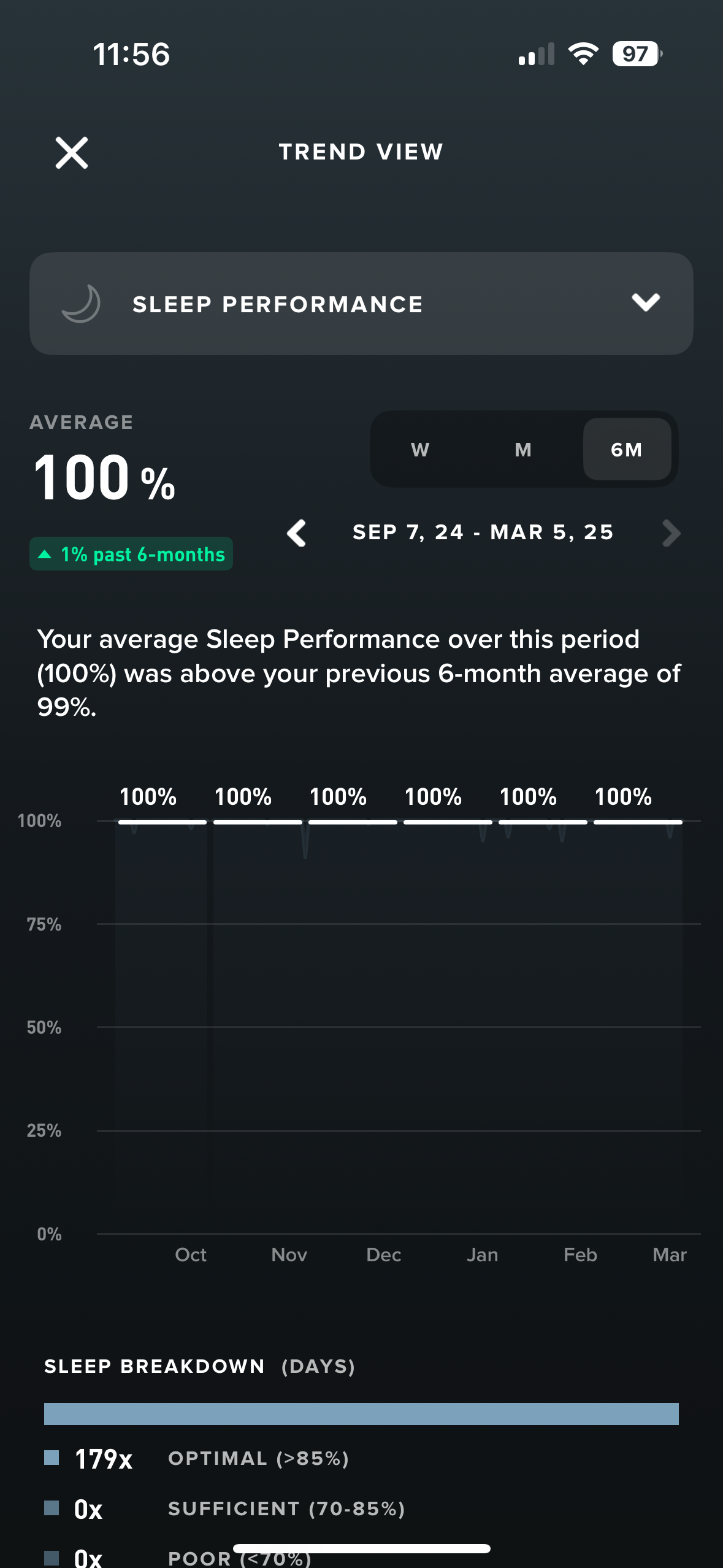
My current sleep stats
Over the past six months, I've spent an average of 9 hours and 15 minutes in bed each day. That's a significant amount of time out of 24 hours, especially when you're running two businesses, one of which is still in its early stages, and have plenty of other ambitions, too. I go to bed at around 8 pm and sleep in almost every day, meaning I wake up naturally, before my alarm, and still much earlier than most people. Although everyone important in my life has got used to this routine, I still get the occasional questioning look. Am I sleeping my life away?
So I find myself asking another question: what am I missing out on by going to bed so early? I can't binge-watch Netflix, which I've never really done anyway and have no desire to start. I can't stay out partying until the early hours, but I no longer want to, having already had my fair share of that in the past. I lead a calm, focused life that doesn't feel like I'm missing out on anything. In fact, this is the happiest phase of my life so far, because I'm healthy and feel at ease with myself (see «Sleep: your underestimated superpower»).
Am I antisocial because I'd often rather sleep than meet up with people? Am I antisocial because I've switched off WhatsApp and would rather write in my journal? Am I antisocial because I don't drink alcohol, something I've never enjoyed anyway? I actually think I have a very active social life. It seems to me that the word «antisocial» is increasingly used to describe anything that not everyone does. And that's exactly what I find troubling about the reactions to Bryan Johnson's lifestyle. We've become very quick to judge and condemn, particularly when something or someone challenges the status quo.
So is Bryan Johnson missing out on life because he spends so much time training and undergoing medical tests, and takes dozens of supplements every day instead of eating burgers or whatever else the people around him associate with enjoyment? Only he can answer that question for himself. And he certainly seems to have one advantage: he appears to be guided by a sense of purpose that gives his life meaning.
Enjoyment, then, is subjective. I enjoy my life much more since I scaled back my social circle to make more room for close relationships, started getting more sleep and began eating more healthily. I don't miss the things I've left behind. But I also understand that other people enjoy Netflix, good food and long nights out. As long as these are conscious choices, that's absolutely fine.
Awareness is everything! Because «an untrained mind is like a drunken monkey»
I find this Buddhist metaphor of the «monkey mind» particularly apt. An untrained mind is neither attentive nor focused. Instead, it jumps from one thing to the next. As a psychologist, nothing fascinates me more than getting to know my own mind, understanding how it works and learning how to optimise it. Among other things, my Mental Strength training programmes focus on recognising thoughts and physical sensations with precision, and responding consciously to stimuli.

Me practising thought and attention training
What fascinates me frightens others. «Won't I turn into a robot if I train my mind?» sceptics ask. «No, you'll become more yourself», I reply. How?
When we learn to:
recognise which patterns were conditioned into us early in life, and which neural blueprints we carry in our minds as a result, shaping everything we do, we can consciously choose new paths and take greater control of our lives;
understand that around 40% of our 6,000 daily thoughts are repetitive (yes, the same thoughts every single day!), and train our perception and cognition to think differently and act differently instead, we can develop new, more positive habits;
identify the triggers we repeatedly encounter, meaning stimuli that provoke disproportionately strong or emotional reactions, and understand how changing the thought that precedes a reaction can change how we feel, we gain far greater freedom to choose how we respond.
When we learn all this and much more, we begin to break free from patterns that aren't truly our own, but rather reflect the environment we grew up in. We can then think, feel and act in ways that are genuinely true to who we are. Until then, we're often caught in the same patterns, repeating them consciously or unconsciously.
Ultimately, the lifestyle you choose is entirely up to you. But if you haven't trained your mind, there's a good chance you're not making those choices freely. And in that sense, you're not acting freely either.
So is Bryan Johnson right when he says «remove your mind», for example, when it comes to food? In my view, yes. Think about those moments when you crave something sweet, even though you know you probably shouldn't eat it. Depending on your habits, a whole range of neurotransmitters can become active, making that sweet treat seem irresistible. That's when you're behaving like a drunken monkey.
But when your mind is well trained, you can recognise these thought patterns and choose to respond differently. You can decide to go without something in the moment because you know you'll benefit more in the long run. That's mental strength, too.
Will training my mind turn me into a robot? No, you'll become more yourself.
The more you train your mind, the greater your freedom to make conscious decisions. In my experience, you also become increasingly independent of external influences.

Some people fear that developing mental strength will turn them into robots
What are the characteristics of people who have trained their minds and developed a «clear mind» as a result? Use this checklist to assess your mental strength.
Area 1: Awareness
You are able to observe your thoughts precisely and are practised in techniques that help you do so, such as meditation or autogenic training.
You can analyse your thoughts and recognise recurring patterns.
You have heightened awareness of physical sensations and can identify where you experience them in your body.
You can accurately assess your energy levels and tension, and understand what drains and replenishes your energy on different levels (physical, mental, emotional, spiritual and more).
Area 2: Self-awareness
You recognise your conditioned patterns and have consciously broken free from them, allowing you to respond freely in situations rather than being trapped in habitual reactions (in other words, you've broken free from «repetition compulsion»).
You know your values and what triggers emotional responses in relation to them. You understand that thoughts lead to feelings, which in turn shape your behaviour.
You recognise not only your triggers but also the compensatory behaviours you used to fall back on, such as holding yourself back from doing something you actually wanted to do.
Area 3: Self-management
You can influence your mood and distance yourself from recurring negative thoughts that serve no useful purpose.
You know your inner saboteur and the thought patterns associated with it. You also know your inner superpower and can consciously activate it when needed.
Area 4: Self-confidence
You have an «objective» understanding of your strengths and weaknesses. You can name and accept them, and consciously draw on your strengths in different situations.
You have a vision for your life and goals that matter enough for you to postpone short-term rewards in pursuit of long-term success.
You have developed a higher level of awareness overall, allowing you to focus better, prioritise more effectively and experience less stress.
If you answer «yes» 8–12 times, you're mentally strong. If you answer «yes» 7 times or fewer, you have the potential to strengthen your mind and, in doing so, create more freedom in your life. Because:
Awareness is freedom. So clear your mind!
The more consciously you choose how to live your life, the freer you become. Whether you then choose a «self-optimised» lifestyle like the one Bryan Johnson appears to lead, or one that places greater value on spontaneity and enjoyment, doesn't matter, as long as your choices are conscious. Discipline can therefore be a form of freedom, even if that may seem paradoxical at first.
So, is your life worth living? Yes, if you live it consciously. No, if you don't. Enjoyment in itself is never the right measure by which to answer this question, even though our society all too often treats it as such. Perhaps that's because our level of awareness is still far from where it could be.

Longevity through a trained mind
Strengthen your mind, too, so you can live consciously! Then «remove your mind» becomes unnecessary. «Clear your mind!» becomes your guiding principle, helping you live not only longer, but certainly better.
And this is what makes longevity complete: looking beyond physical ageing. A well-trained mind can also contribute positively to a longer life. There is a growing body of evidence to support this, yet in my view, the psychological dimension receives far too little attention in discussions about longevity. Mental strength can have a significant positive impact on your physical health, for example through meditation, a sense of purpose and mental training:
Protecting telomeres through mental training: Meditation may help preserve telomeres, the protective caps at the ends of chromosomes. Longer telomeres are associated with slower cellular ageing.
Epigenetic effects of meditation: Meditation can positively influence gene expression. This has been described as a slowing of the «epigenetic clock» and is associated with better health.
Living longer through a sense of purpose: The seven-year Ohsaki Study, involving more than 43,000 participants, found that people with a stronger sense of purpose in life had significantly lower mortality rates.

I didn't always understand the meaning of life. Today, however, I'm one of those people who want to live as consciously as possible and for as long as possible.
One of my reasons is that I want to spend as much time as I can with my daughter, whom I had at 40. I also keep looking for ways to grow and improve, because personal growth is one of my core values.
What are you striving for? What makes your life worth living?